When Vibe Coding Stops Being Enough
Vibe coding has changed how ideas turn into software. Instead of writing code line by line, you describe what you want and let AI build it
for you. With the right tools, just about anyone can now create a website, product, or service without ever opening a code
editor.
Platforms like Replit, Cursor, Bolt, Lovable, and others make this even easier. You do not need to install anything locally. The platform handles the code, the environment, and even a private preview of your app. Some tools go a step further and let you deploy your vibe coded product publicly without any technical experience at all.
This is genuinely exciting. Ideas that once stalled at the technical hurdle can now be explored in days instead of months. Founders, product managers, and the general population can now bring a vision to life and see it working in front of them.
But there is a point where vibe coding stops being enough.
Why Vibe Coding Works So Well at the Start
Vibe coding is excellent at turning intent into output. You focus on what the system should do, and the AI fills in the how. That makes it perfect for:
- Prototypes and demos
- MVPs and proof of concept builds
- Testing whether an idea resonates
- Exploring workflows and features
At this stage, speed matters more than structure. You are learning, iterating, and adjusting based on what you see. Vibe coding removes friction and keeps momentum high.
The problem is that success at this stage can be misleading.
Where Things Start to Break Down
The more complex a product becomes, the harder it is to rely purely on vibes.
AI generated software is designed to work in the moment. It optimises for getting something functional quickly, not for how that system will behave months or years down the track. As soon as real users, real data, and real expectations enter the picture, cracks begin to show.
Common issues include:
- Code structures that do not scale as features are added
- Security gaps caused by unsafe defaults
- Data handling that was never designed for real volumes
- Performance problems once usage increases
- Difficulty changing or extending the system without breaking it
Without technical experience, it is extremely difficult to recognise these issues early. Everything can appear to work perfectly until it suddenly does not.
This is why many vibe coded products stall at the prototype stage. They prove the idea, but they are not built to survive the real world.
How Software Engineers Use AI Differently
Software engineers also use AI heavily. The difference is not the tools; it is the understanding behind them.
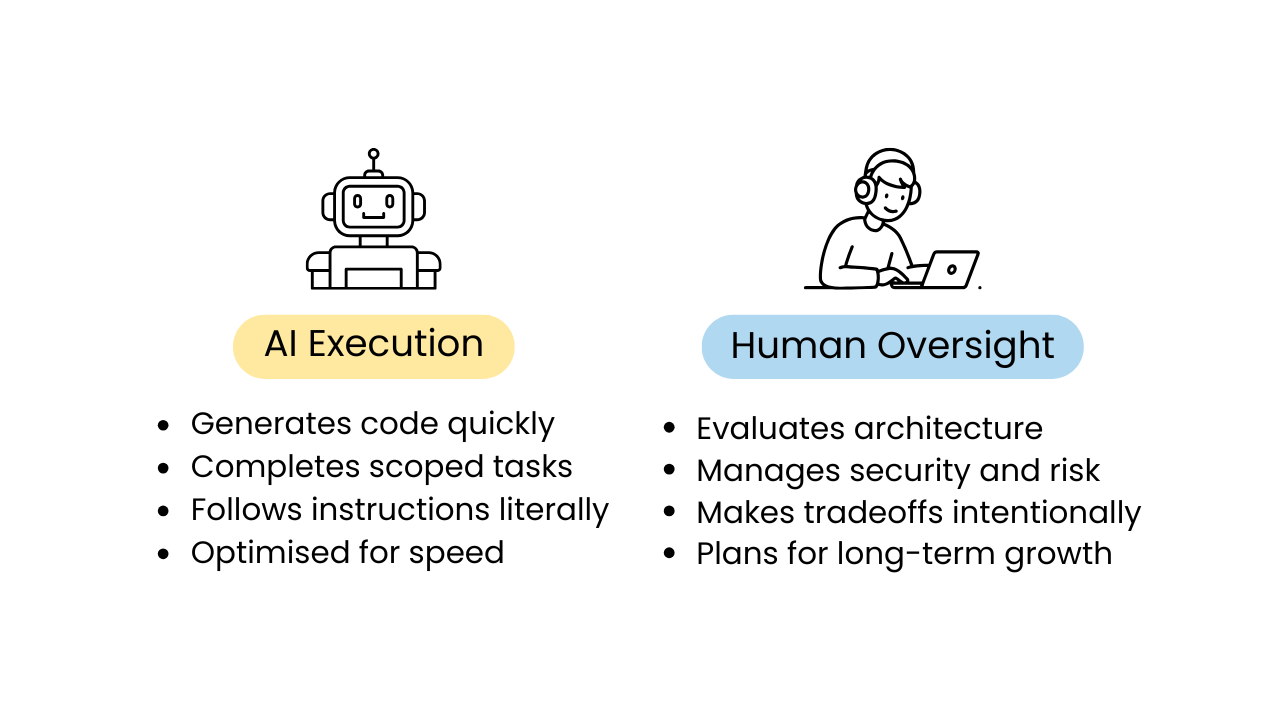
Experienced engineers know how to evaluate what the AI produces. They understand architecture, security, performance, and long-term maintainability. That allows them to use AI to speed up the less critical parts of development while still making intentional decisions about the system as a whole.
A useful way to think about AI in software development is as a very fast very junior engineer. It can write valid code and complete tasks when guided well, but it does not understand the broader context. It cannot design a system, make tradeoffs, or anticipate how today’s decisions affect tomorrow’s growth.
With the right planning and oversight, AI can absolutely be part of a production-ready solution. Without that guidance, it cannot get there on its own.
Knowing When to Pivot
Vibe coding is not something you abandon. It is something you outgrow.
The pivot usually comes when:
- Your prototype is turning into a real product
- You are preparing for customers, not just demos
- Data security and compliance start to matter
- Scaling, hosting, and reliability become priorities
- You need confidence that the system will hold up long term
At this point, the question shifts from “can we build this?” to “can this support real world use?”
That is where experienced engineering becomes essential.
How WorkingMouse Helps You Move Beyond Vibe Coding
Vibe coding is a powerful starting point. WorkingMouse helps you finish.
We work with teams who have early prototypes, demos, or AI generated systems and need to turn them into scalable, secure, production ready software. Sometimes that means strengthening what already exists. Sometimes it means reworking the solution with the right architecture underneath. The approach depends on the vision and the current state of the product.
Our team combines engineering expertise with our Codebots technology to keep delivery fast while ensuring quality, stability, and longevity. We help bridge the gap between experimentation and real world systems that people can rely on.
Start with vibe coding, pivot when it matters, and finish with WorkingMouse. Book a chat to take the next step.



.png)