What is Vibe Coding
Software development is changing. Instead of writing every line of code by hand, people are increasingly describing what they want and
letting AI take care of the implementation. This approach is known as vibe coding, a term introduced by Andrej Karpathy in
2025,
and it is quickly reshaping how software gets built.
Vibe coding lowers the barrier between an idea and a working product. You focus on intent, behaviour, and outcomes, while the AI handles the mechanics needed to make it real.
How Vibe Coding Works
Vibe coding is the practice of building software using natural language prompts instead of manual coding. You describe what the system should do, and the AI generates the code to support it.
The workflow is simple and intuitive. You outline a requirement, review what the AI produces, and refine it as you go. Rather than spending time on repetitive or low-level implementation details, developers shift into a guiding role. They shape logic, flow, and structure while the AI fills in the gaps.
For non-developers, this opens the door to building things that previously required a full technical team. For experienced engineers, it offers a faster way to explore ideas and move through early stages of development.
At its core, vibe coding is about:
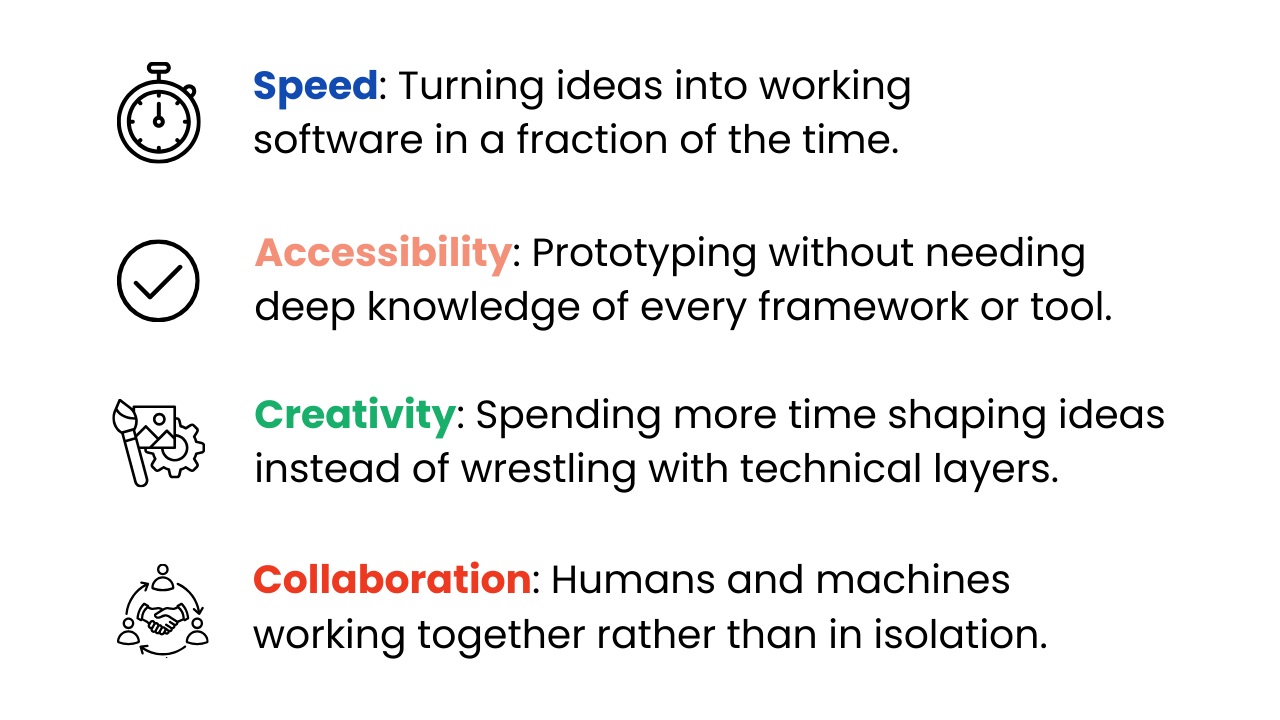
Vibe coding is not a replacement for good engineering. Architecture, judgement, and experience still matter. What it does is change where
effort is spent and who can participate in the process.
Platforms You Can Use to Vibe Code
A growing number of platforms support this style of development, each with a slightly different focus. Most of
these tools abstract away parts of the traditional development workflow by combining code generation, environment setup, and
deployment into a single experience.
| Platform | Best for | Strength | Trade-off | Link |
| Replit | Small projects, experiments, early demos | Rapid prototyping, web-based, highly accessible | Less suited to deep customisation | https://replit.com/ |
| Cursor | Developers wanting AI inside an IDE | AI-assisted code generation and refactoring in-editor | Assumes a traditional developer workflow and experience | https://cursor.com/ |
| CodeConductor | End-to-end system creation | Prompt-driven generation of full stack, deployable systems | Focused on complete systems rather than individual snippets | https://codeconductor.ai/ |
| Lovable | MVPs, prototypes, internal tools | Fast delivery of production-style code from prompts | Reduced fine-grained architectural control | https://lovable.dev/ |
| Bolt.new | Early exploration and experimentation | Minimal setup with fast feedback loops | Best suited to small applications and prototypes | https://bolt.new/ |
| Base44 | App creation with minimal technical skill | Builds and maintains full codebases via abstraction | Heavy reliance on automation and abstraction | https://base44.com/ |
Taken together, these tools make it possible to move from idea to implementation faster than ever before, often without installing anything
locally or managing infrastructure directly.
IDE Integrated and Workflow Oriented Tools
It is also worth noting that not all AI assisted development tools exist as standalone platforms. Several offerings are designed to work alongside developers inside their existing IDEs and workflows, rather than abstracting software delivery into a separate system.
Examples include OpenAI Codex, Google’s AntiGravity, and Claude’s coding capabilities. These tools focus on augmenting the developer within their current environment by assisting with code generation, refactoring, reasoning, and navigation, rather than replacing the development workflow itself.
In a related but distinct category are tools like n8n, which support multi step, agentic workflows that orchestrate LLM calls and external services. While not strictly ‘vibe coding’, these tools are often used to build LLM driven automation and integration pipelines, complementing AI assisted development rather than replacing it.
This distinction is important. Some tools prioritise abstraction and speed by providing end-to-end platforms, while others prioritise developer control by embedding AI assistance directly into existing tools and processes.
The Limits of Vibe Coding
Vibe coding is an excellent way to get started. It helps turn ideas into working prototypes quickly and makes experimentation accessible. But once a project moves beyond the early stage, its limitations become clearer.
One of the most visible issues is that AI generated output often looks and feels the same across different products and platforms. Many AI driven builders are trained on similar examples and workflows, which means they tend to produce familiar UI structures, application flows, and architectural patterns. When using tools like Base44 in particular, it is common to see very similar layouts, processes, and interaction models emerge, even when the underlying problem is different. Overtime, this can make products feel generic or obviously AI generated.
AI generated code can also look correct even when it is not built to last. The AI may choose approaches that work in the short term but do not scale well or only fail under real world conditions. During early testing everything can appear stable, which makes it easy to assume the foundation is solid when it actually needs closer review.
Early success can also lead to overconfidence. A feature that works in isolation may start to break down once more functionality is layered on top, or when the system is exposed to real users and production traffic.
Security is another common weak point. AI systems often rely on convenient defaults or widely reused patterns, some of which are unsafe in production environments. These issues usually remain hidden until the application is used in unexpected ways or subjected to real world abuse.
Vibe coding is a powerful way to begin, but taking a product to a dependable, real world level still requires experienced engineering. Someone needs to review the AI’s choices, shape the architecture, and make intentional decisions so that early shortcuts do not turn into long term problems. That is the part AI cannot replace yet.
How We Can Help
Vibe coding gives you a fast way to explore ideas and build early momentum. When you reach the point where stability, security, and scalability matter, WorkingMouse helps you take the next step.
WorkingMouse can transform early prototypes into robust systems built for real world use. Whether you are modernising an existing platform or preparing a vibe coded prototype for production, our team and our Codebots technology provide the structure, oversight, and long-term support that AI tools alone cannot.
Up next, we dive into How to Take Your Vibe Coded App to the Next Level.



.png)