Using The Lean Ux Canvas To Validate Your Product
Some years ago, the head of the Industrial Engineering Department of Yale University said, "If I had only one hour to solve a problem, I would spend up to two-thirds of that hour in attempting to define what the problem is."*
We love solving problems - it's what gets us up in the morning. There is nothing more significant for us than when we do this for our customers. However, in working as an external vendor, there are several issues which can block the correct definition of what the problem is.
There are two critical reasons for this:
- Time: A commercial time-based engagement encourages both parties to focus on solution delivery over problem definition.
- Domain Expertise: As a vendor, we trust you as the domain expert to bring the domain expertise. However, this domain expertise is often confused with user needs. Neither parties can prescribe the user needs; only the end users can.
In 2019, we had great success moving to a problem driven approach to agile software development. The process has gone a long way to ensuring we are solving the right issue. Despite this, we felt we needed to go further in providing initial guidance to our customers.
The Lean UX Canvas
So, we asked ourselves. How can we discover more at an early stage, retain this and get a complete understanding of the situation before we begin to solve the problem? In researching, we discovered the Lean UX Canvas by Jeff Gothelf.
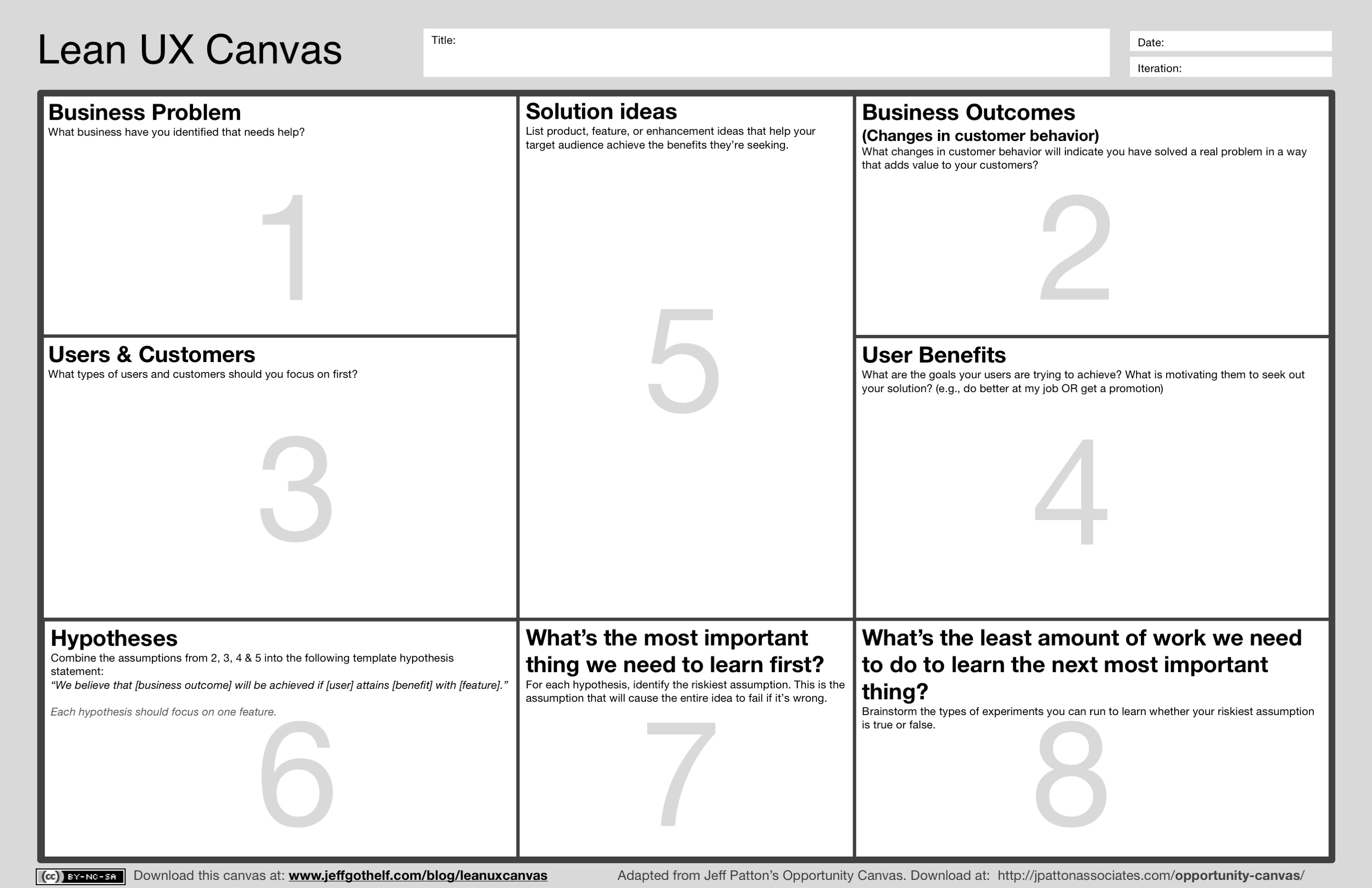
In summary, Jeff developed the canvas for the following purposes:
- A customer-centric cross team facilitation tool.
- Help the team focus on 'Why' they are doing the work.
- A recipe for teams to adopt agile.
- Ensure learning takes place every iteration.
- To expose gaps in teams understanding.
- A first step to shift the conversation from outputs to outcomes.
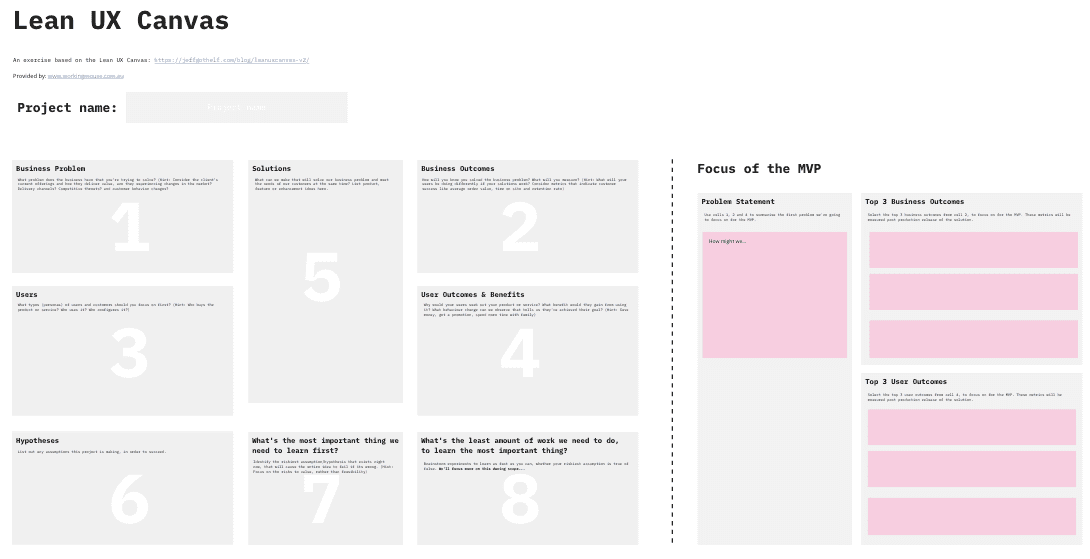
Here's Jeff's canvas:



.png)