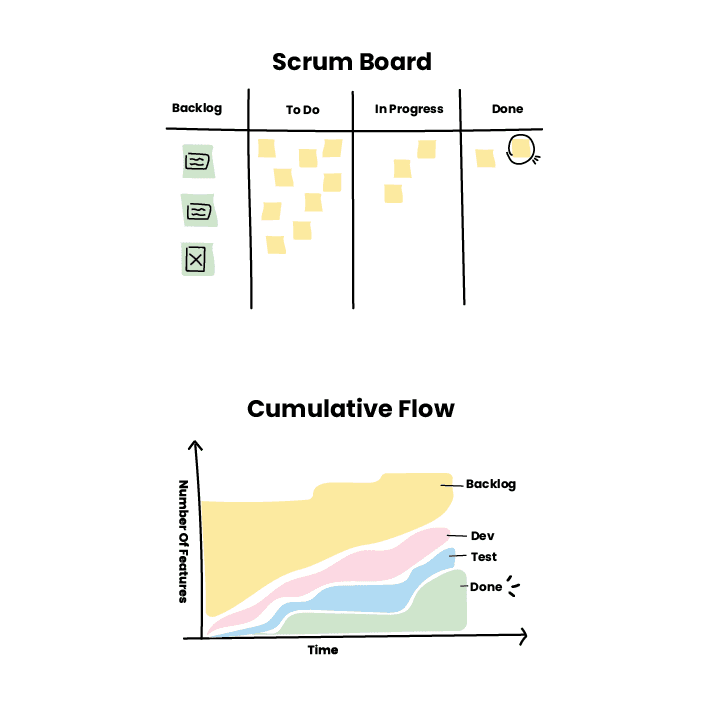
The two methods run the same project board. Issues flow through in the following sequence: To Do, In Development, Testing & Done. The
difference is that Scrum has two stages before: a Product Backlog (which encompasses everything) and the Iteration Backlog (all
functionality that will be completed in this iteration). The reporting on Scrum is via a burndown chart that tracks issue completion against
iteration time. This can be summarised as the project's velocity. The Kanban reports are the lead and cycle times that feed into the
Cumulative Flow diagram.
Again, this comes down to product responsiveness very project planning, and the type of project you are undertaking. In my experience, I've
never seen a Scrum project with an empty product backlog. There will always be more to do, and there will always be technical debt. Does
removing the product backlog free you as the product owner from this and enable a forward-thinking mindset or, is it essential that this
detail is never lost?
Summary
As you will now see, there's a fairly big difference between the two models. It may be best to reflect on how you like to work as a product
owner? Do you prefer to work in a planned manner or reactively? Traditionally, Scrum works better for large projects that require structure
such as software outsourcing while Kanban is between for fast changes, support/maintenance, and bug fixing. At WorkingMouse, we use the
Scrum method in our Way of Working for project development but allow a Kanban approach to support where our clients choose what is going
into support production or doesn't. We hope this article helps you find your Way of Working for your project.




.png)