Jidoka at MODELS 25
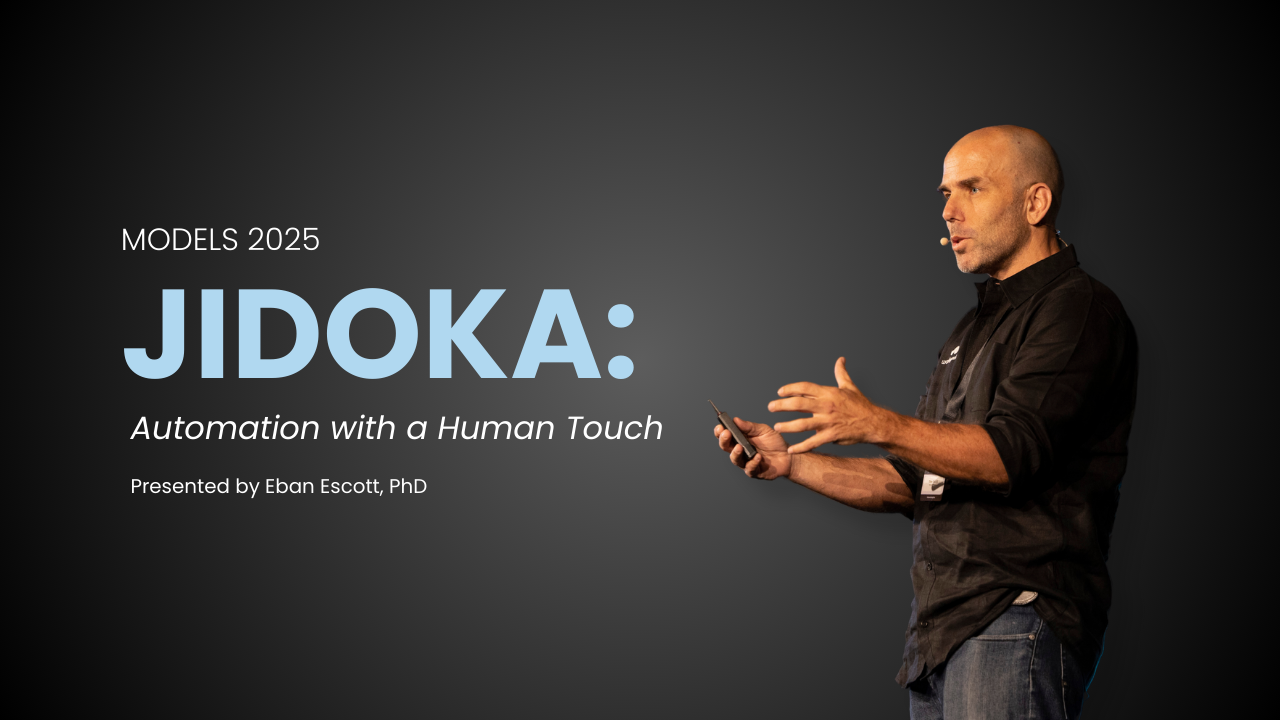
At this year’s MODELS 2025 conference, WorkingMouse founder Dr Eban Escott presented his latest work on Jidoka, our methodology designed to break the legacy cycle and enable continuous modernisation. After more than 100 modernisation projects, Jidoka brings together the lessons we’ve learnt and the principles we rely on when working with complex public and private sector systems.
The presentation, Jidoka: Automation with a Human Touch, explored how Model Driven Engineering (MDE), DevOps, and AI can work together to create software delivery processes that are predictable and easier to maintain. It’s built on the same themes we reinforce across our modernisation work: humans and machines collaborating to produce higher quality outcomes than either could alone. Legacy systems grow increasingly difficult and costly to maintain, trapping teams in cycles of rebuilds. Jidoka offers an alternative path.
Breaking the Legacy Cycle
Many organisations find themselves locked into replacing legacy systems every few years. Over time this becomes expensive and disruptive, making it harder to maintain quality and retain system knowledge. As the system ages, the level of risk also increases.
Jidoka reframes modernisation as a continuous, model-centric process. Rather than rebuilding systems from scratch, we create a journey where organisations stay in control of their technology, not controlled by it.
To explain how, the presentation walked through the three phases that define the Jidoka approach.
The Three Phases of Jidoka
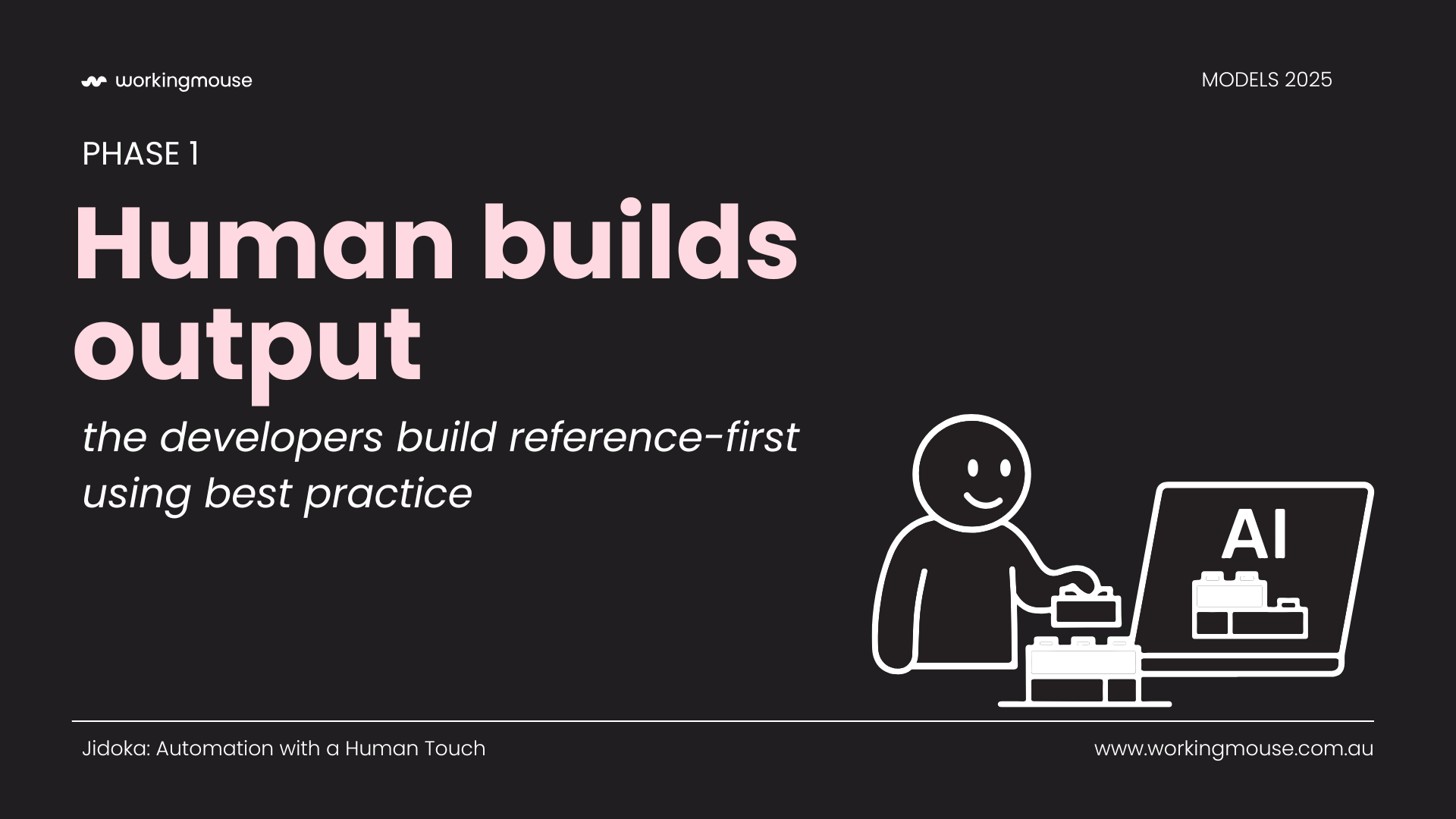
Phase 1 – Human builds output
Every project begins with a clear reference point. We build an example of the output using best practice development. This sets the benchmark for quality, behaviour, and structure.
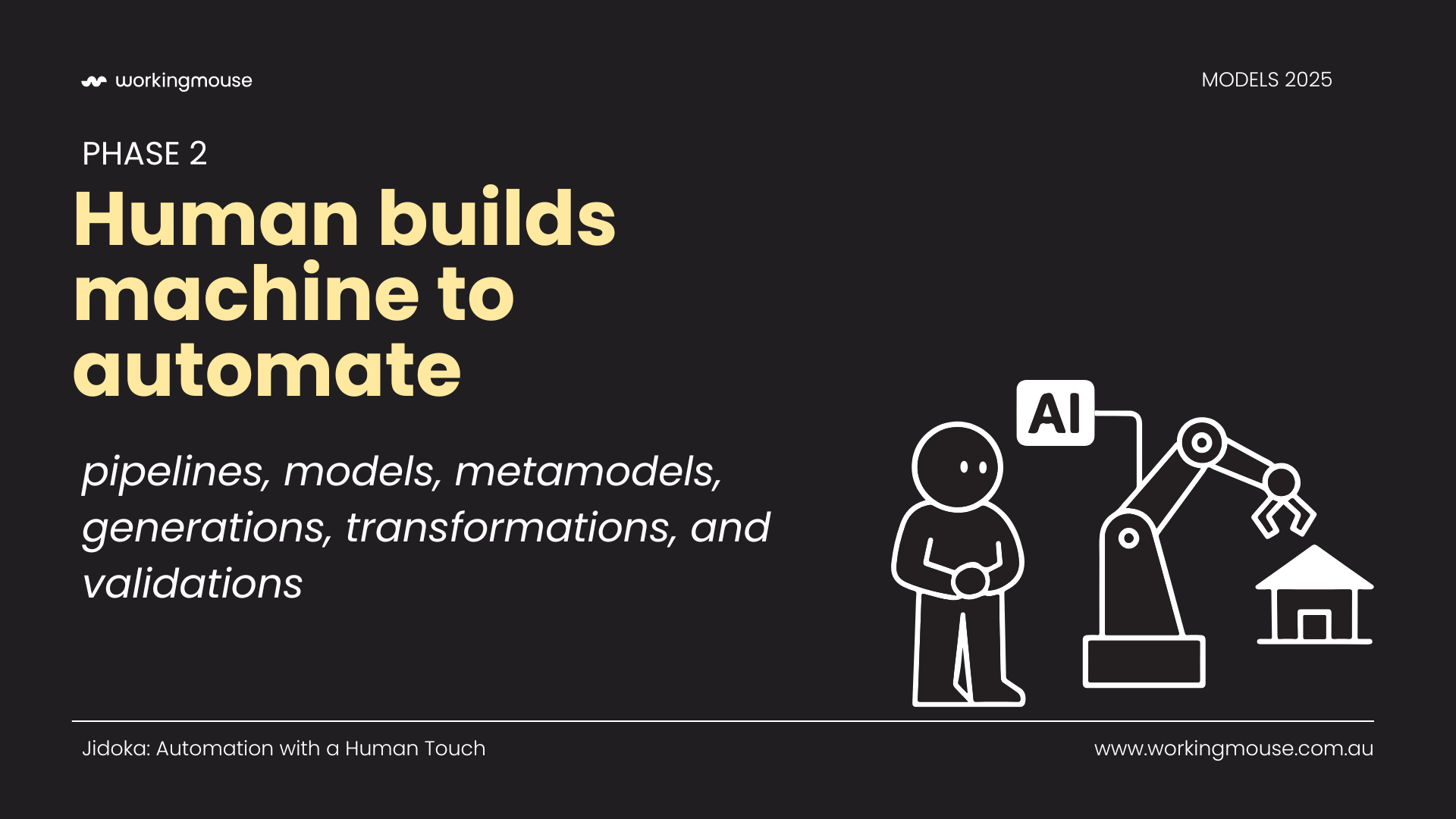
Phase 2 – Human builds the machine to automate
Once the baseline exists, we construct the automation around it. This includes models, metamodels, pipelines, transformations, validations, and generation rules. This is where the long-term value is created, because it allows us to reproduce consistent outcomes at scale.
Phase 3 – Machine alerts human when quality is breached
Finally, automation supports ongoing quality. Testing, analytics, and feedback mechanisms monitor behaviour and notify humans whenever something falls outside expectations. People stay in control, supported by tools that preserve quality.
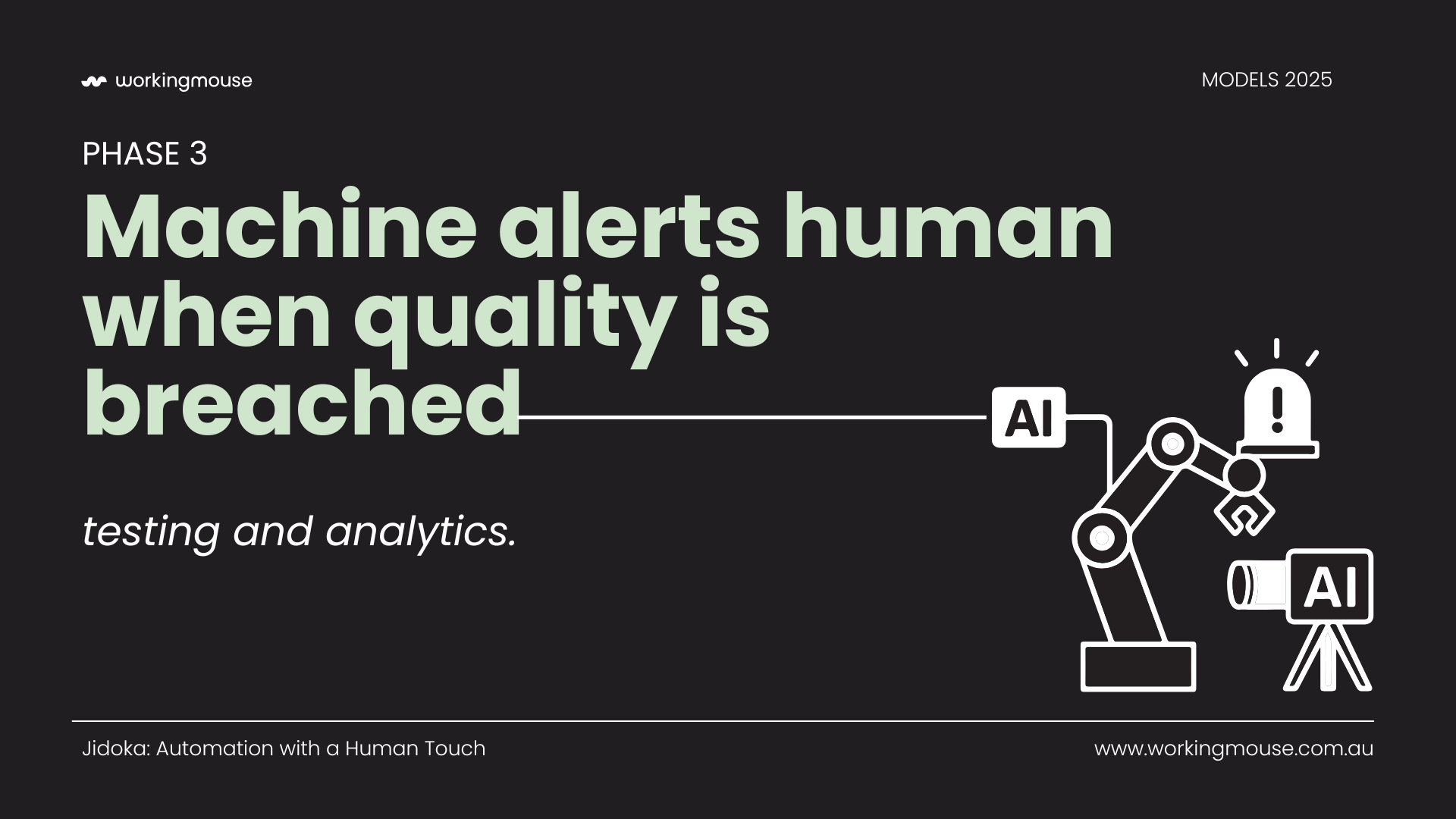
These phases work together to create a repeatable cycle of continuous modernisation rather than repeated rebuilds.
Why Combine MDE and DevOps?
DevOps improves the speed and consistency of deployment, while MDE gives teams a clearer way to understand and automate systems. Used together, they create a stronger and more predictable development process. This combination has been important in our large-scale modernisation work.
.png)
Modernising Brownfield Systems Through Breadth-First Understanding
A key message in the talk was that legacy (brownfield) environments behave very differently to greenfield builds. Because a system already exists, we need to respect its business processes, data, and user behaviour before making changes.
To do this, we use a breadth-first strategy. By breaking down legacy interfaces into components, we can identify patterns, consolidate logic, and map out functional coverage early in the process. This approach reduces risk and helps create shared understanding across the team.
Making Modernisation Work: The Goals Board
To help everyone understand how the system fits together, we use a tool called the Goals Board. It gives a clear view of each application, component, and platform capability, making it easier for our team and our clients to stay aligned on priorities and progress.
By visualising the system, we:
- align stakeholders
- identify risks early
- prioritise high-value areas
- support model-driven planning
- create a shared language across technical and non-technical contributors
This level of visibility is a big part of why our modernisation projects stay on track, even in complex environments.
.png)
A Real Industrial Example: Eight Applications. One Modern Platform.
The presentation included a real case study: a large industrial application with over 20 years of legacy behind it. Across an 18-month project, we modernised:
- eight business applications
- a shared model-driven core
- automated documentation
- data migration with traffic light validation
- business logic using model-based testing
This example showed that Jidoka is not just a methodology. It works in practice, even at scale, and without disrupting day-to-day operations.
The Ten Principles of Jidoka
To close the talk, Eban outlined ten principles we apply across all modernisation work. These principles are central to how WorkingMouse delivers high-quality outcomes:
- Empower teams with AI and high-quality tools.
- Treat everything as a model and build bridges across the organisation.
- Record knowledge simply and centrally in the code repository.
- Use pipelines to improve quality and enable automation.
- Address high-risk issues early.
- Align administration effort with actual risk.
- Prioritise non-functional requirements.
- Avoid altering business processes during modernisation.
- Keep the end in mind and enable continuous modernisation.
- Apply each principle pragmatically and with balance.
These principles put humans at the centre of the process, supported by systems designed to enhance quality and reduce risk.
Humans and Machines Working Together
The final message from the presentation captured the essence of Jidoka: humans and machines working together achieve the highest-quality outcomes.
At WorkingMouse, our mission is to modernise legacy systems in a way that strengthens teams rather than replacing them. Jidoka provides a structured, scalable, and human-centred way to do exactly that.
If you're looking to modernise an ageing system or break free from the legacy cycle, our team can help you apply Jidoka to your environment and plan a path towards continuous modernisation.



.png)